
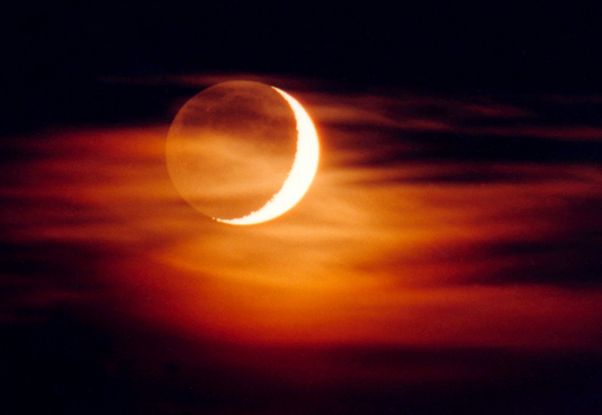
'Blessed be the blood on my skirt, blessed be the blood on my thighs, blessed be the blood', sings Carolyn Hillyer on 'Old Silverhead'. For many years, I have been fascinated with the power and significance of women's cycles, of our monthly menstrual blood. We bleed in synchronicity with the moon's waxing and waning, we bleed continously for about five days and we do not die.
.
What fascinates me just as much is Western society's relationship with women's blood. At best, menstrual blood is ignored and hidden away, at worst it is called 'the curse' and viewed as 'disgusting'. Women suffer of PMS, of menstrual pain, and many of us wish that we were not afflicted with this 'condition'. We take pain killers, 'get on with it' and pretend it's not happening. What is behind this strange attitude towards one of our body's most natural functions?
.
Interestingly, in some cultures, menstruating women are highly respected as it is believed that women are at the height of their spiritual powers at this time. The veils between the mundane and the spiritual world are said to be thin for bleeding women, which facilitates psychic and intuitive abilities. In the old days, and still in some indigenous tribes now, women retreated into seclusion with other women when they bled. During this time, the men, and/or older post-menopausal women respect their space and take care of household tasks such as cooking and cleaning.
.
Two years ago, I visited the Kalash tribe in Northern Pakistan. The Kalash are a pagan tribe who dwell in the Hindu Kush mountains close to the Afghan border. Every month, all menstruating women retreat into the bashaleni, the tribe's menstruation and birth house, for five days. The women use this time to rest, sleep and lie around the fire. Older women cook for them and bring them food. This practice gives the women some time out from an otherwise harsh life in the mountains.
.
The onset of menstruation used to be celebrated, and still is in some traditional cultures. 'Among certain Australian aborigines, the young girl used to be buried up to her waist in warm sand to assist the first flow, and she was fed and cared for by her mother in a sacred place. Later she returned to the tribal camp to celebrate the feast marking her entry into womanhood. In some parts of India, kumaripuja was, and is, celebrated at the time of first menstruation. On the first day, having attained womanhood, the girl is worshipped by family and friends as the incarnation of the maidenly aspect of Shakti - Kumari, symbol of purity and promise. Kumari later grows into Parvati who becomes the consort of Shiva. The kumari is showered with gifts and flowers, and is presented with her first sari.' (from 'Nawa Yogini Tantra' by Swami Muktananda)
.
In the Indian tantric tradition, in which the body is viewed as something noble and pure blood is sacred. 'Tantrikas specially honour the menstruating woman', writes Daniel Odier in 'Desire: The Tantric Path to Awakening', 'because they believe her to be at the height of her femininity; she is seated to the right of the master in Tantric gatherings, and menstrual blood is a sign of unfolding power at its peak. Ascetics willingly use menstrual blood to draw on their foreheads.'
.
I love this reverence of the blood, of life, and the marking of what is essentially an important rite of passage. I sorely miss it in our mainstream culture, and this is one of the reasons I started to train as a priestess - to help bring back an understanding and honouring of the natural life cycles: birth, menarche, sex, menopause, death. For me, every new stage, every transition in life is a wonderful time, too precious to let slip by unnoticed.
.
I certainly noticed that, when I started to honour my moontime and allowed myself rest and space, my menstrual pain and PMS decreased significantly. I realized that the pain was trying to tell me something. It was telling me to slow down, to take note. I now like to spend the first two days of my moon time in near-seclusion, sinking into 'dreamtime'. I like to connect with the body of Mother Earth, the fertile earth from which we all came. I love to lie on the land and feel her pulsating beneath me. I offer her some of my blood every month as a symbolic act of giving back to her, our Mother, affirming that I honour my fertility, my being a woman. By bleeding into the ground, I symbolically nourish her as she nourishes me, nourishes all of us. It strengthens my connection with her, with the land and the elements. I use my moon time to rest, to vision, to dream, to write, to read. To spend time with myself and feel into what is going on in my body. Admittedly, taking this time out can be hard for many working women - indicating how removed we are as a society from the natural cycles of our bodies. I was amazed to learn that in South Korea, every woman has the right to take between one to three days off every month to rest during her menstrual cycle. When my dear Korean friend Hee told me this, I was stunned; she was equally stunned that we don't have such a law in place. But even if we can't all take several days off every month, maybe we can simply slow down, tune into our bodies, take some time out, and postpone tasks that are not absolutely necessary. Maybe we can connect with other women once a month, at the Full Moon or the New Moon, to share, to dream, to be. Such practices also re-align us with the moon cycles, so that we bleed in rhythm with the moon again.
.
Honouring my blood is also an act of all-encompassing acceptance of myself, of the human being, and dissolving the illusionary separation between 'good' and 'bad', 'pure' and 'impure', 'light' and 'dark'. In tantrism, we accept everything. Everything comes from Source, everything is sacred.
.
Jai Mata Kali!
.
Some inspirational further resources:
.
* read 'The Red Tent', written by Anita Diamant
* watch 'Bloodtime, Moontime, Dreamtime', a poetic documentary by Roberta Cantow (www.originaldigital.net/bmd/)
* Moon Times eco-friendly Menstrual Products (http://www.moontimes.co.uk/)
* visit the Soul Fire Heart Centre in Wellhouse Lane, Glastonbury - the centre has a beautiful Blood Garden where you can lie on sheepskin rugs on the land just beneath the Tor and offer your blood to a special flower bed (telephone Draupadi 07952.739961)
* join Deborah Tual's 'Sacred Blood' online course at http://groups.yahoo.com/group/red-moon/
.
Practical tips to attune yourselves with your cycle and ease menstrual cramps:
.
* Practice some simple yoga postures, like vajrasana (thunderbolt pose), shashankasana (hare pose), marjari-asana (cat/cow pose) and shavasana (corpse pose)
* Practice deep abdominal breathing
* Cut out sugar and processed foods
* Up your magnesium and zinc levels (a naturopath or nutritionist can advise on correct intake levels)
* Try to feel into the pain, meet it with curiosity, surrender to it. When we do that, rather than push it away, it often dissolves.


 The real beloved is that one who is unique, who is your beginning and your end. When you find that one, you'll no longer expect anything else: that is both the manifest and the mystery.

